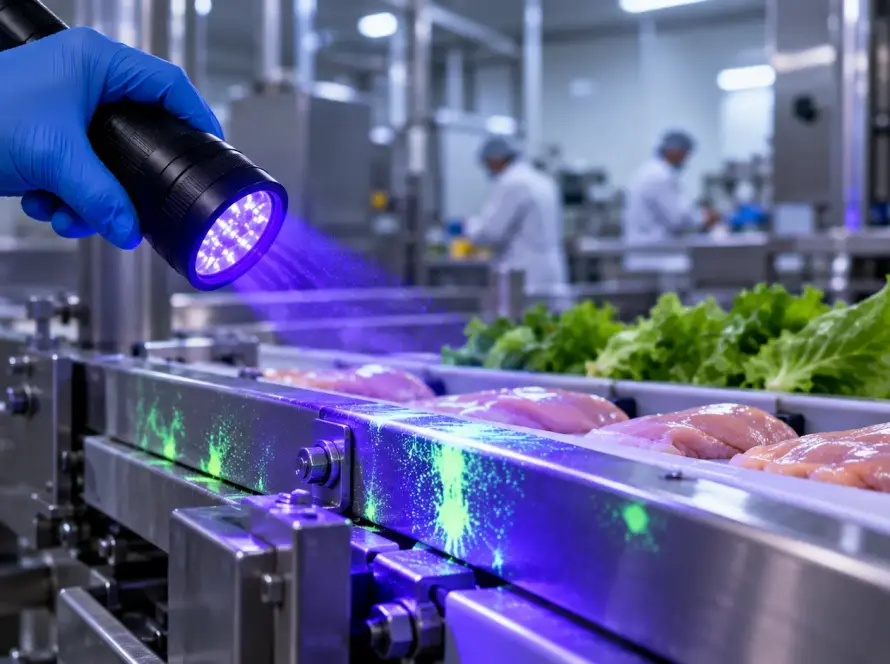
In food processing plants, organic material and early microbial growth often remain in locations that appear acceptable under normal lighting. Standard visual checks and routine sampling frequently miss these issues. UV inspection lamps address this gap by making certain residues more visible during hygiene inspections. Teams can then identify problem areas more effectively and strengthen cleaning verification. When applied consistently, the method gives food safety inspection programmes a clearer view of what remains on equipment and surfaces after cleaning.
In this detailed blog post, we will walk you through why contamination requires high-tech attention, how UV inspection lamps help detect contamination, key applications, and how BioDtex can help.
Why Hidden Contamination Is a Concern in Food Processing
Many high-risk locations are difficult to reach in everyday lighting and operating conditions. Routine visual inspections show only what is immediately apparent. Yet food residues, organic matter and early microbial growth tend to settle where access and illumination are limited.
See how UV inspection lamps uncover what routine cleaning misses.
Contamination in Hard-to-Reach Areas
Joints, corners, seals, drains and conveyors slowly collect residue. These areas are challenging to clean thoroughly and equally difficult to inspect by eye alone. They require deliberate attention before becoming a longer-term source of risk.
Residues That Are Difficult to See
Thin layers, dried product or scattered organic matter can blend with surface colour or remain in shadow. A surface that appears clean under normal lighting may still retain material capable of supporting later microbial growth.
Biofilm Formation
Persistent residues provide a surface for microbial attachment. Over time, microorganisms form biofilms in the food industry, which are structured communities enclosed in a protective matrix that resists ordinary cleaning and disinfection. Once established, biofilms become harder to remove and can act as ongoing reservoirs of contamination. Identifying residual organic matter at an early stage helps limit the conditions that allow biofilms to develop.
What Are UV Inspection Lamps?
UV inspection lamps are specialised light sources that emit ultraviolet radiation, typically in the UV-A range. During hygiene inspections, they are directed at cleaned surfaces. Certain residues and substances absorb the light and re-emit it as visible fluorescence. This provides a rapid visual indication of areas, without complex preparation or laboratory processing. Organic matter, some food residues and material associated with microbial activity become more readily differentiable against the background surface.
How UV Inspection Lamps Help Detect Hidden Contamination
The process is straightforward and integrates readily into existing hygiene routines.
Inspecting Surfaces After Cleaning
Once cleaning is complete, the lamp is used to examine food-contact and adjacent surfaces. Teams move systematically across equipment and work zones, noting any fluorescence that signals residual material. Flagged areas receive additional cleaning or further investigation.
Detecting Residual Organic Matter
Many residues fluoresce under suitable UV illumination. The resulting glow draws attention to organic material left during routine visual checks. Cleaning teams can then direct effort to the precise locations that still require attention.
Identifying High-Risk Areas
Particular focus is placed on joints, crevices, corners, seals and other confined locations. Incorporating UV checks into routines for these high-risk zones makes inspections more targeted and effective.
Supporting Biofilm Detection
UV illumination can highlight areas that demand further investigation for possible biofilm or microbial contamination. Fluorescence indicates residual organic material or biofilm formation.
Improving Cleaning Verification
Comparing findings before and after cleaning, or tracking recurring problem locations across successive cycles, reveals where procedures need adjustment. Observed patterns help refine equipment focus, cleaning methods or operator practices for more consistent long-term control.
Key Applications of UV Inspection in Food Processing
UV inspection can be incorporated into routine hygiene checks across multiple areas of a food processing facility.
Processing Equipment
Mixers, filling equipment, production lines and other food-contact surfaces benefit from regular UV examination. It helps confirm that cleaning has reached all relevant surfaces, including those with complex geometry.
Conveyors and Transfer Areas
Zones where product moves between processing stages often accumulate residue on belt edges, rollers and transfer points. UV inspection of these locations supports more complete verification after cleaning.
Seals, Joints and Hard-to-Reach Areas
Seals, joints and confined spaces are frequently missed during manual inspections. UV lamps make residual material in these places more apparent so that corrective action can be prioritised.
Food Preparation and Production Areas
Work surfaces and adjacent non-food-contact zones can be included in routine hygiene verification. UV inspection provides a consistent visual method across different areas of the plant.
Cleaning Verification
As part of a structured post-cleaning inspection process, UV lamps deliver rapid visual feedback. They complement existing methods such as ATP testing by directing teams to the most relevant sampling points and confirming the effectiveness of sanitation procedures.
Benefits of Using UV Inspection for Food Safety
Faster Visual Inspection
Teams can examine larger surface areas more efficiently. Immediate visual feedback reduces the time required to locate potential problem zones compared with purely manual checks or extensive random sampling.
Helps Identify Missed Cleaning Areas
Residues that might otherwise remain unnoticed become easier to locate and address. This supports more thorough cleaning and reduces the likelihood of carry-over into the next production run.
Supports Consistent Hygiene Practices
A repeatable visual approach helps maintain consistency across shifts and operators. Clear, observable results make standards easier to uphold.
Helps Reduce Contamination Risks
Early identification of hygiene gaps allows corrective action before residues develop into more persistent problems. This proactive step strengthens overall food safety inspection effectiveness.
Supports Staff Training
Visual findings under UV light provide clear demonstrations of residual contamination. These observations help hygiene teams refine technique and reinforce a practical understanding of what an adequately cleaned surface looks like.
BioDtex Solutions for Advanced Hygiene Inspection
BioDtex Lamp
The BioDtex Lamp is a handheld UV-A device designed for use in food processing environments. It enables teams to identify areas requiring cleaning attention or further investigation by revealing residual organic matter and material associated with biofilm formation. The lamp integrates with existing hygiene inspection workflows, works alongside current cleaning and sampling routines, and provides rapid visual results.
BioDtex Scope
The BioDtex Scope efficiently inspects difficult-to-reach or confined spaces that a standard handheld unit cannot fully cover. It is particularly useful for joints, seals, internal surfaces and other restricted locations, allowing inspection beyond easily accessible surfaces.
These solutions from BioDtex strengthen biofilm detection in food processing and support more reliable food contamination detection within a comprehensive hygiene programme.
Conclusion
Hidden contamination is a concern in food processing, as residues and early microbial growth frequently escape routine visual checks. UV inspection lamps offer a practical, non-destructive means of making certain residues visible. It enables teams to locate problematic areas, verify cleaning effectiveness and maintain more consistent hygiene standards. Combining UV inspection with existing methods and targeted corrective action provides facilities with a clearer path to reducing contamination risks.
BioDtex is a leading manufacturer of advanced biofilm UV lamps and UV scopes. Our tools are made using advanced technology and high-end sensors. This ensures that every hidden contamination is detected. Also, request a demo if you are looking for tools for biofilm inspection in the UK.
Strengthen your food safety inspection process with BioDtex UV solutions.
FAQs
They are used during hygiene inspections to illuminate cleaned surfaces so that residual organic matter and other fluorescing substances become visible. This enables the team to direct their attention to areas that require further cleaning or investigation.
UV inspection lamps illuminate certain residues under UV light, making material that is difficult or impossible to see under normal lighting stand out. This guides inspectors to missed cleaning locations and high-risk zones such as joints and seals.
Yes. They can indicate areas that may contain residual organic matter or early biofilm formation through fluorescence. The glow functions as a visual indicator supporting further investigation.
Residues accumulate in hard-to-reach places and remain invisible during ordinary checks. Persistent organic material can support microbial growth and biofilm formation, increasing the risk of product contamination if not addressed.
Frequency depends on the facility’s risk assessment, production schedule and hygiene plan. Many operations include UV inspection post-cleaning verification or schedule it at defined intervals for high-risk equipment and zones.